Donate Now
Topic » Gender
A woman’s ability to plan her family is critical to gender equality and empowerment. Unplanned pregnancies that result from a lack of contraceptives impede a woman’s ability to support herself. For teenage girls, early pregnancy often brings an end to education – a 2008 study in Uganda found that one-third of adolescent mothers dropped out of school, and that young mothers were half as likely to be able to support themselves and more likely to experience gender-based violence. When women are decision-makers in their families, they spend more resources on their children’s nutrition, health care and education.
PAI works to empower women through reproductive health care. We advocate for gender to be considered in policymaking on issues ranging from climate change to HIV treatment.
Policy Brief
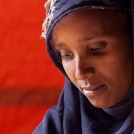
Gender-Based Violence: A Threat to Women’s Reproductive Health
Gender-based violence (GBV) knows no boundaries. It cuts across societies, classes, races, religions and ethnicities, affecting an estimated one in three women in the course of her lifetime. While some acts of GBV have garnered public attention, such as armed … Continue reading
Downloads
Post
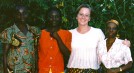
Why Female Peace Corps Volunteers Deserve Better
This post was also featured in the Huffington Post. Serving in the Peace Corps in the Central African Republic is part of what inspired me to work in the reproductive health field. As you’ll see in the above video, my … Continue reading
Post
Unfair Sacrifice: Female Peace Corps Volunteers Deserve Equal Access to Abortion Care Under Federal Health Plans
This post was originally published on RH Reality Check. Peace Corps is an amazing experience. I wouldn’t trade the two years I spent in a small village in rural Morocco for any other time. I regularly tout the virtues of … Continue reading

Article
Engaging Women Leaders in Miami
Miami, Florida is well-known for its beautiful beaches, flavorful food and cultural diversity. It is also home to several important Members of Congress, an economic hub in the South and a critical gateway between the United States and the rich, … Continue reading

Press Release
Population Action International and Atlas Corps Welcome Nigerian Nonprofit Leader
PAI awarded Distinguished Partner Award March 12, 2012 Washington, DC – Atlas Corps is proud to announce the placement of its eighth Fellow, Mikang Longjan from Nigeria, at Population Action International (PAI). PAI is an organization that advocates for women … Continue reading

Post
Bird-Dogging Birth Control
On International Women’s Day, people around the world should ask: “How do we involve, educate and inspire girls globally?” We believe that access to contraception and comprehensive sex education are two non-negotiable pieces of this formula. We have progressed far … Continue reading
Policy Brief
Why Population Matters to Poverty Reduction
Around 1.4 billion people—one-quarter of the population of the developing world—lived on less than $1.25 a day in 2005.1 The World Bank projects that the number of poor people will increase in the coming years due to slowing economic growth, … Continue reading
Policy Brief
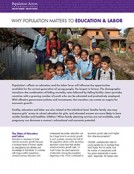
Why Population Matters to Education
Population’s effects on education and the labor force will influence the opportunities available for the current generation of young people, the largest in history. The demographic transition—the combination of falling mortality rates followed by falling fertility rates—provides countries with a … Continue reading
Downloads
Video
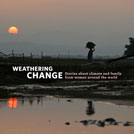
Weathering Change
Weathering Change takes us to Ethiopia, Nepal and Peru to hear the stories of four women as they struggle to care for their families, while enduring crop failures and water scarcity. As the world’s population hits 7 billion in 2011, the film shows how women and families are already adapting to environmental challenges that threaten their health and their livelihoods. Continue reading
Video
Weathering Change Trailer
Weathering Change follows women in Ethiopia, Nepal and Peru as they struggle to care for their families while enduring crop failure and water scarcity. The film explores how family planning can help women adapt to environmental challenges to their health and livelihood. Continue reading